Grand Exchange prices: what OSRS and RuneScape numbers mean
A price on a Grand Exchange page describes an observation. It does not reserve an offer for you. Before buying materials or comparing a sale with alchemy, check which game the item belongs to, what the displayed price measures and when it was observed.
Last trades and guide prices
In Old School RuneScape, the high and low prices supplied by the wiki's price service describe recorded trades. Each side has its own observation time. The last high price is a useful purchase reference and the last low price is a useful sale reference, but the next matching offer may have a different price. A historical average is also different from an individual last trade.
RuneScape's guide price is a single reference value. It is not a separate instant-buy and instant-sell pair. Treating the same guide price as two executable offers invents liquidity that the observation does not contain. Enter the prices you are actually prepared to use when comparing a trade.
An Old School Rune scimitar and a RuneScape Rune scimitar are separate items. Their equipment rules and alchemy values differ. Switching games changes the item catalog and saved planning context instead of matching them by name.
Read history without inventing missing trades
Choose a time range that matches your decision. A short range can help inspect recent changes; a longer range gives context for a price that looks unusual. The chart identifies its available interval. An interval average does not show every trade inside it.
A missing observation is not a zero-coin sale. Gaps remain gaps rather than a straight line suggesting continuous prices. A recorded fallback can still help with preparation, but its dates remain visible and its values should be checked before placing an offer.
Volume and buy limits answer different questions
Volume describes recorded trading activity over a stated interval. It does not tell you how many coins you can earn from that activity, and a volume figure without a known interval should not be relabeled as hourly volume. Compare like-for-like intervals when sorting items.
A buy limit restricts the quantity you can acquire within its four-hour allowance. The planner can show the recorded item limit, but it does not know how much of your allowance you have already used. Placing another offer does not reset that allowance. Stock already held can cover a crafting goal even when the next purchase is limited.
Assess a purchase of 1,000 Nature runes in RuneScape
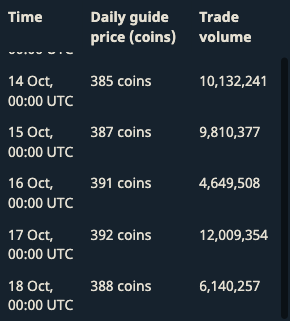
Suppose you are considering buying 1,000 Nature runes. Open Nature rune price and volume history, then expand Observation table to compare a date's guide price with its traded quantity.
The historical row for 17 October 2026 records a 392-coin guide price and 12,009,354 Nature runes traded. These are separate observations: the quantity does not say what price each trade used. It does not show how many runes are available for your offer now, establish a purchase price or predict how quickly 1,000 runes will buy. Scroll the table to keep the date, price and quantity together.
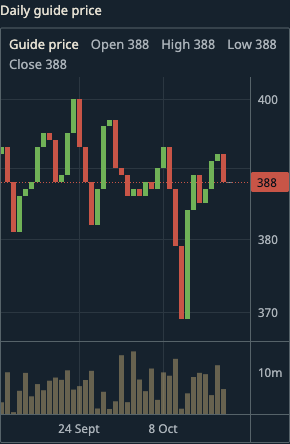
The candles show guide-price changes. After the first candle, each opens at the preceding recorded guide price and closes at that date's guide price; its high and low span those guide values. They are not the highest and lowest prices paid in individual trades. The bars below show dated traded quantities. Unknown means a quantity is missing; a recorded 0 means zero units.
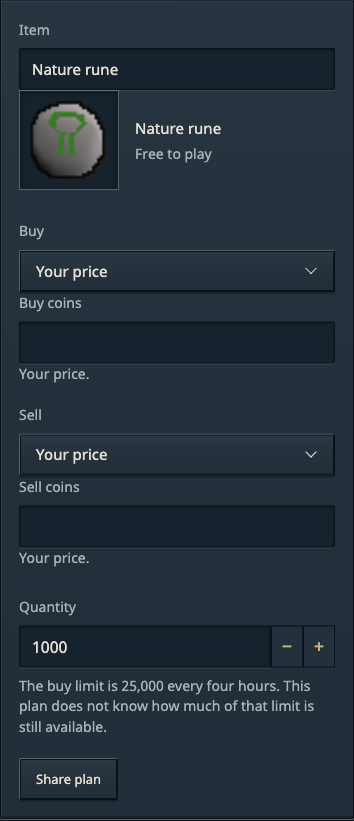
Choose Trade to carry the item and quantity into a purchase-and-sale comparison, or open trade calculations for 1,000 Nature runes directly. Supply the buy and sell prices you want to evaluate. The historical guide price does not establish either offer. Your assumptions stay with the plan when you go back to the market and return.
Follow the same item into a decision
Start with Old School exchange prices or the separate RuneScape exchange. Select the actual item and inspect its price and history before choosing a quantity.
For a resale, use the trade planner to count per-item tax and the first whole break-even sale price. For a spell, compare alchemy after nature and fire rune costs. For a crafted item, plan the materials rather than treating its sale price as profit.
A price you type is an assumption. Keep it fixed while comparing your options; newer observations should not silently replace it. A plan can be shared with a link without turning it into a claim that a trade has occurred.
Price-source references
The defines the recorded high/low observations and historical intervals. Compare the RuneScape example with using the same dates. Neither page reserves an offer for you.
From the community
Share discoveries, advice and screenshots with other players. Found an error on this page? Report a mistake
Loading player contributions…
Join the conversation
Checking your account…